
Allison's Story: Spot the Woman
At a mining investor conference, Allison played a game she often play: spot the woman. That question, and the patterns she kept observing, eventually led her to Maven. This is the story of how frustration became collaboration, and how four women decided to build something different.
THE STORY OF MAVEN
Allison Coppel, Founder and Chief Sustainability Officer
1/22/20265 min read
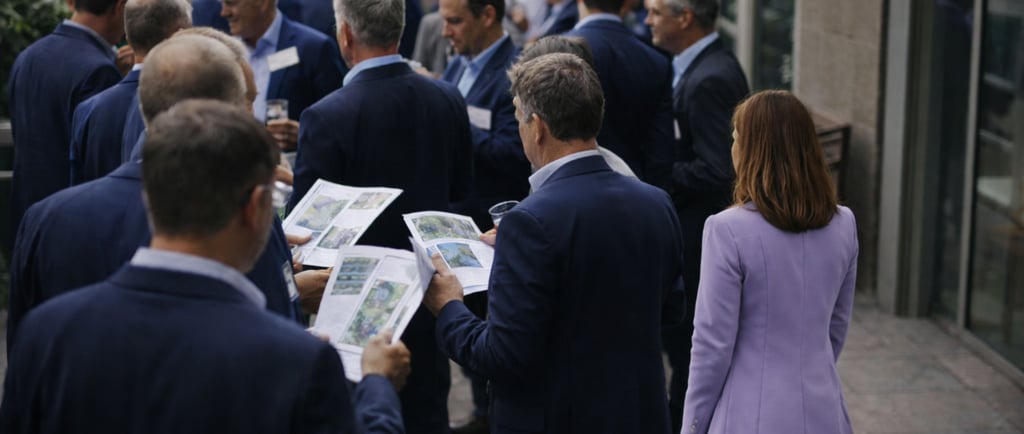
A few years ago, I was at a small mining investor conference. During one break I stood on the patio outside the venue. The space was crowded with exploration company CEOs showing printed, colorful decks to investors. I took a photo that I still look at sometimes. Navy blue sports coats, light colored button up shirts, and clean cut hair. Almost entirely white men, mostly middle aged and older.
I played a game I play at many mining conferences. Spot the woman. I could not find one in that photo.
I said out loud to no one in particular, “Another reminder of why it is like this.” What I meant was, the “like me” bias is strong. The same fraternity shows up again and again. There was not an open table for me to sit at. I stood awkwardly off to the side next to a potted plant.
There were women at the conference. I knew many of them already, including Kelly Ward, who would later become one of my Maven co-founders. When we found each other, the bond felt chemical and we were pulled together. I spoke easily with many people at the event, but the sense of relief around my female friends was different.
I kept asking myself where all the women were, and why they were not there. Not only as professionals, but as investors. Who gets early access to these conversations matters. Who feels welcome enough to shape conversations, to ask questions, to take risk matters.
Where is this project, actually
At that same conference, I spent most of my time asking investors and exploration company CEOs about ESG, and more specifically about community issues. The pattern was familiar. Many CEOs quickly flipped open their decks, pointed to maps and charts, and talked about the potential riches of their projects.
I would listen, then ask a simple question. Where physically in the world is this project?
Sometimes I would get a country. Sometimes a general region. I almost never heard the names of nearby communities, or even the county or district. The social context was vague, if it existed at all.
More than once, I heard a version of this statement. “We don’t have social risk.”
My follow up question was usually internal. How do you know that if you do not even know the names of the communities involved?
One quote stuck with me because I heard it more than once. Social risk isn’t a problem because I’ve got a guy.
Each time, I felt myself tense. What does that mean? His entire understanding of social risk reduced to the opinion of a single guy. I was there to listen, and none of this was new to me. It was another reminder of why it is like this.
Mining exploration is often framed as technical and remote. Rocks, drill results, maps. But these projects sit in real places, with people and ecosystems that already exist. Ignoring that context does not remove risk. It just pushes it down the timeline.
The conversation that changed the direction
A few months later, I listened to a podcast episode where Beth Borody CDI.D was the guest. She talked about wanting to help more women become investors in the mining sector, especially at the exploration stage. By then, Beth and I had already had several intense and energizing conversations about the absence of female investors in mining. I told her about my conference experience. She laughed in empathy, and then did something practical and typical of her. She translated that empathy into action, and pulled me into a series of training sessions to help women learn how to invest in mining.
Then she said something that stopped me cold. She described a vision of a female run mining company. A feminist mining company. An operating company where women were in charge.
I remember saying out loud, “This is too much.” And yet, I could not let it go.
I left her a voice note inviting her to interview me for my podcast, Planet | People | Mining. It was my season two finale, exactly a year after I had signed my first Pacha Associates contract. Her podcast, The Rebuild, had helped me process a painful professional transition. The day I first listened, I pulled over on the way to meet a friend in Annapolis, Maryland and cried for twenty minutes. That episode gave me language for what I was going through.
She immediately said yes to the interview. Toward the end of our conversation, without planning it, we started brainstorming out loud. What could collaboration look like? How could we get more women investing? How we were already working together to get one project funded, and how fun and meaningful that felt.
The episode ended with an open sentence. Yes, let’s do that.
I did not know then that Beth would take that energy and translate it into a registered holding company. That I would become a co-founder a few months later. That we would become Mavens.
Finding my other mavens
In February 2025, at the SME Conference in Denver, Kelly drove me back to a friend’s house. It took me an hour to get out of the car. We talked about Beth’s idea of bringing women together to invest in mining. What if we brought Beth’s network to our networks. What if we created something together? What would it even look like?
Around March 2025, I reached out to Peggy Bell. I needed help with Pacha Associates. I could see a path forward that went beyond survival. I needed a website, a brand, and a clearer way to explain what I did. Peggy helped me articulate an identity. Pacha took off.
All of this converged into Maven.
For me, Maven exists to show that it does not have to be so hard. Mining exploration is risky. Failing to understand who considers land to be theirs when a project is staked increases uncertainty. Failing to recognize the natural environment around a mineral deposit as part of the system increases uncertainty. Sometimes this looks like refusal. Often it is a form of informed ignorance, reinforced by being surrounded by people who look and think the same way it’s always been done.
Beth gave me a place to take years of frustration and turn it into questions we could act on. What if a project idea starts with mapping a real place. Naming the people who are there. Seeing the environment as it actually exists. Looking at the area as a whole and asking what paths forward are realistic.
I have spent years dissecting delayed mining projects. Again and again, the delays trace back to weak relationships, poor understanding of environmental systems, and a series of internal decisions to avoid doing that work early. I also like making money. I like financial stability. I like planning for my kids’ university education and husband and my retirement. From my perspective, stewardship and long-term value are connected.
Mining investments at the exploration stage take a long time. They produce potential, not production. What exists today is a set of ideas, assumptions, and early decisions. What is still being built is the path forward. At Maven, we are testing what it looks like to be transparent about that path. To name uncertainty. To bring participants along as we learn.
It is not simple. We will face problems. What feels different is the commitment to face them openly, in real places, with real people.
That is the work I am here to do. If you are curious about how mining investment can be approached with more clarity and care, I am open to the conversation.